

If you start saving at the end of October, putting away $1,000 before Christmas means finding about $125 every week for eight weeks. That’s a lot of money if your paycheck is already spoken for.
Table of contents
- First, check how many weeks you have
- The eight-week challenge for a late start
- The twelve-week plan gives your paychecks more room
- Start 26 or 52 weeks ahead if you can
- Work out what Christmas actually costs your household
- Where the weekly deposit money could come from
- What to do when you miss a week
- Get the free Christmas savings challenge printable
- A few questions before you start
- Start with your next payday
I’d start a Christmas savings challenge by working backward from the gifts, holiday groceries, and travel you actually plan to pay for. Then I’d choose a weekly amount that fits the bills. Some families can reach $1,000. Others will get far more use from a $250 or $500 fund, especially with only a few weeks left.
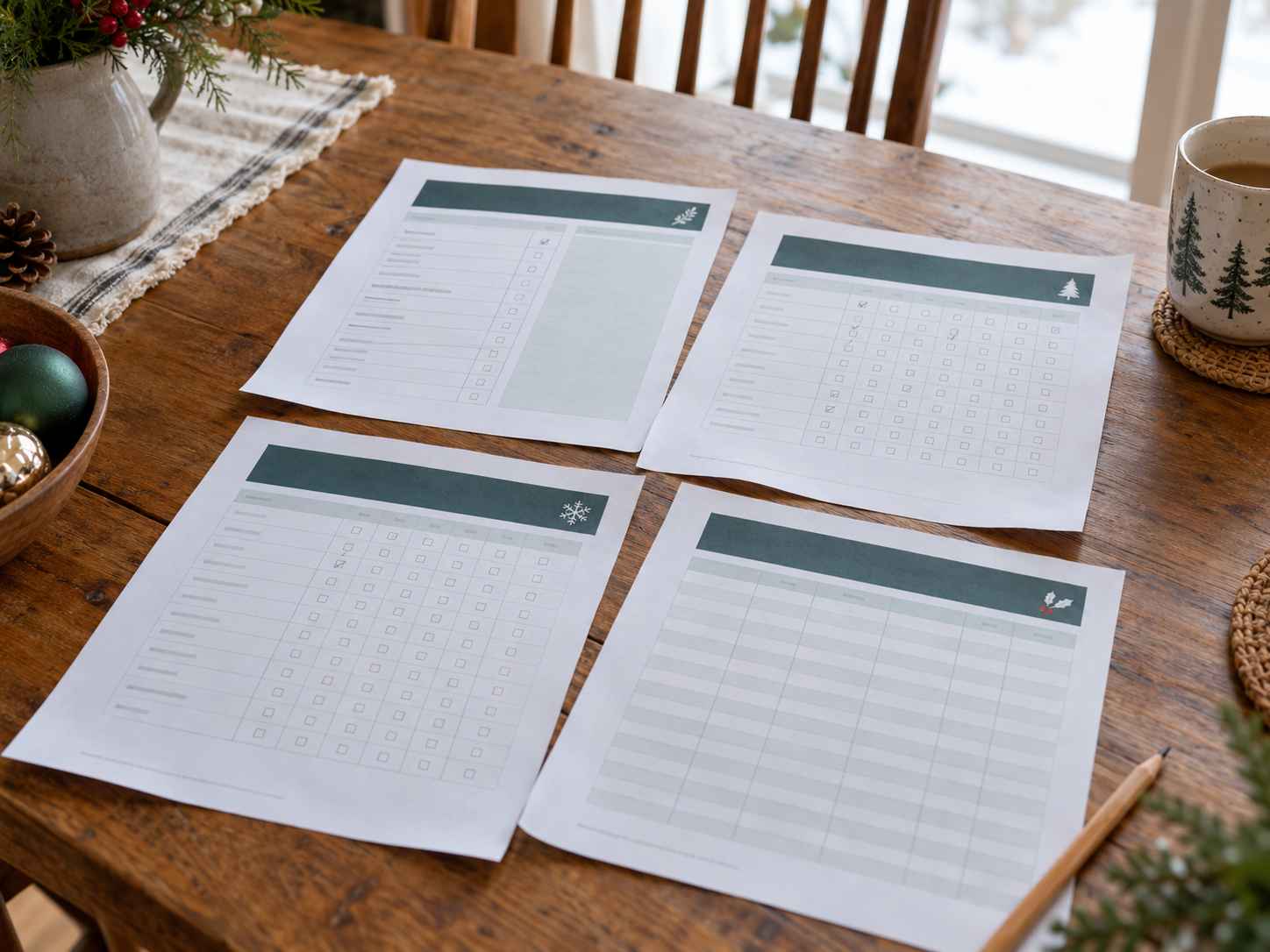
I’ve included a free four-page savings tracker with an eight-week plan, a twelve-week plan, and a flexible chart you can reuse next year. You can print it and fill in each deposit as it happens.
First, check how many weeks you have
Open your calendar and mark the day you need the money. I wouldn’t use December 25 as the finish date if you buy most gifts earlier in the month. If you’ll be shopping by December 18, that’s the day your savings need to be ready.
The amount per week changes a lot depending on when you start.
| Time to save | To reach $1,000 | To reach $500 | To reach $250 |
|---|---|---|---|
| 8 weeks | $125 a week | $62.50 a week | $31.25 a week |
| 12 weeks | About $83.34 a week | About $41.67 a week | About $20.84 a week |
| 26 weeks | About $38.47 a week | About $19.24 a week | About $9.62 a week |
| 52 weeks | About $19.24 a week | About $9.62 a week | About $4.81 a week |
For the rows with cents rounded up, make the final deposit a little smaller so the total lands on your chosen goal. The printable includes a twelve-week schedule that reaches exactly $1,000 without awkward pennies.
If you’ve already saved $200 and want $1,000, the amount you still need is $800. Divide that by your remaining weeks. With eight weeks left, you’re looking at $100 a week instead of $125.
The CFPB’s savings plan worksheet follows the same approach: pick the goal, count the weeks, and work out what you can put away. I like that better than a random challenge chart with no connection to payday.
The eight-week challenge for a late start
For a family starting in late October, eight deposits of $125 would add up to $1,000. The money has to be available after regular bills, though. If $125 each week would put groceries or rent at risk, I’d cut the Christmas target before making the first transfer.
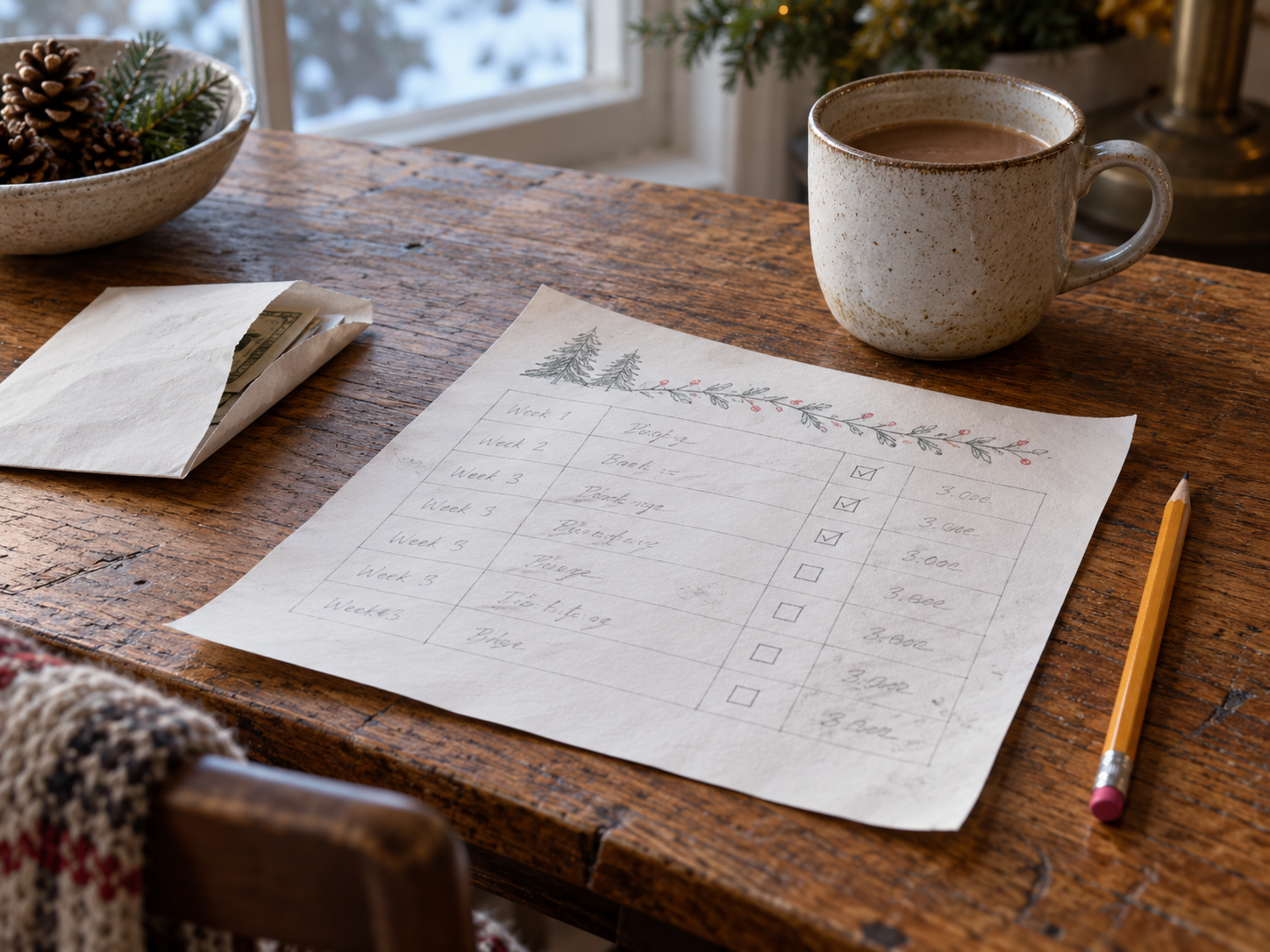
The printed eight-week chart keeps the amount the same each week:
| Week | Put aside | Total saved |
|---|---|---|
| 1 | $125 | $125 |
| 2 | $125 | $250 |
| 3 | $125 | $375 |
| 4 | $125 | $500 |
| 5 | $125 | $625 |
| 6 | $125 | $750 |
| 7 | $125 | $875 |
| 8 | $125 | $1,000 |
For 2026, someone making weekly Friday deposits on October 30, November 6, November 13, November 20, November 27, December 4, December 11, and December 18 would finish before the final Christmas shopping weekend.
But your paydays may be different. Pick the dates on your own calendar.
If you get paid every two weeks, that’s usually four deposits across an eight-week stretch. Reaching $1,000 from zero would take $250 per paycheck. A $250 Christmas fund over the same period would take $62.50 per paycheck.
And if you’re starting in mid-December, the eight-week chart is better saved for next year. Putting a $1,000 target on the fridge won’t create extra December paychecks.
A smaller version I’d choose on a tight budget
Say your bills leave about $35 a week. Set a $250 goal and move $31.25 on payday for eight weeks. You’ll save $250 and keep a little breathing room rather than trying to hit a four-figure number you can’t comfortably fund.
That $250 could cover a modest gift list and the extra groceries for a holiday meal. Start by writing down those actual costs, so you know what the money is for.
The twelve-week plan gives your paychecks more room
Twelve weeks is a good middle ground if you begin around the start of fall. For $1,000, the simple math is roughly $83.33 per week. I prefer using whole-dollar amounts on a paper tracker, so the printable has eleven $84 deposits and one final $76 deposit.
That’s exactly $1,000.
Someone starting a twelve-week plan in late October won’t finish it before Christmas 2026. Use it for a longer goal, start it earlier next holiday season, or lower the amount you’re trying to save.
If the target is $500 over twelve weeks, put aside $42 in each of the first eleven weeks and $38 in the last one. That also totals exactly $500. For $250, save $21 for eleven weeks and $19 in the last.
One small advantage of this plan is that the deposits are predictable. You can see whether $84 genuinely fits before you commit. That matters more than adding an exciting color-in box to the fridge.
Try saving every payday instead
If weekly transfers don’t match your income, work from your actual paycheck dates. Someone with six paydays before their deadline would need about $166.67 per check to reach $1,000 from zero, with a small adjustment on the final transfer.
Write each deposit beside the corresponding payday. If one paycheck includes a large insurance bill or rent payment, use a smaller deposit there and make up the difference only when a later check can cover it.
Start 26 or 52 weeks ahead if you can
The shorter challenges are handy for late starters, but I prefer a longer Christmas savings plan when money is already tight. Saving around $20 a week over a year is easier to fit beside groceries than finding $125 a week at the end of October.
At 26 weeks, the $1,000 target needs about $38.47 a week. At 52 weeks, it’s around $19.24 a week. You can round deposits up and make the last one smaller when the target is reached.
For Christmas 2027, start shortly after Christmas 2026 and give yourself close to a full year. You might use a recurring transfer of $20 a week for 50 weeks and finish with $1,000 before the December rush. That also leaves two weeks in a 52-week period without a required deposit.
If you get 26 paychecks over the year, $38.50 from each of the first 25 and $37.50 from the last makes $1,000. That regular amount is easier to plan around than a big December catch-up deposit.
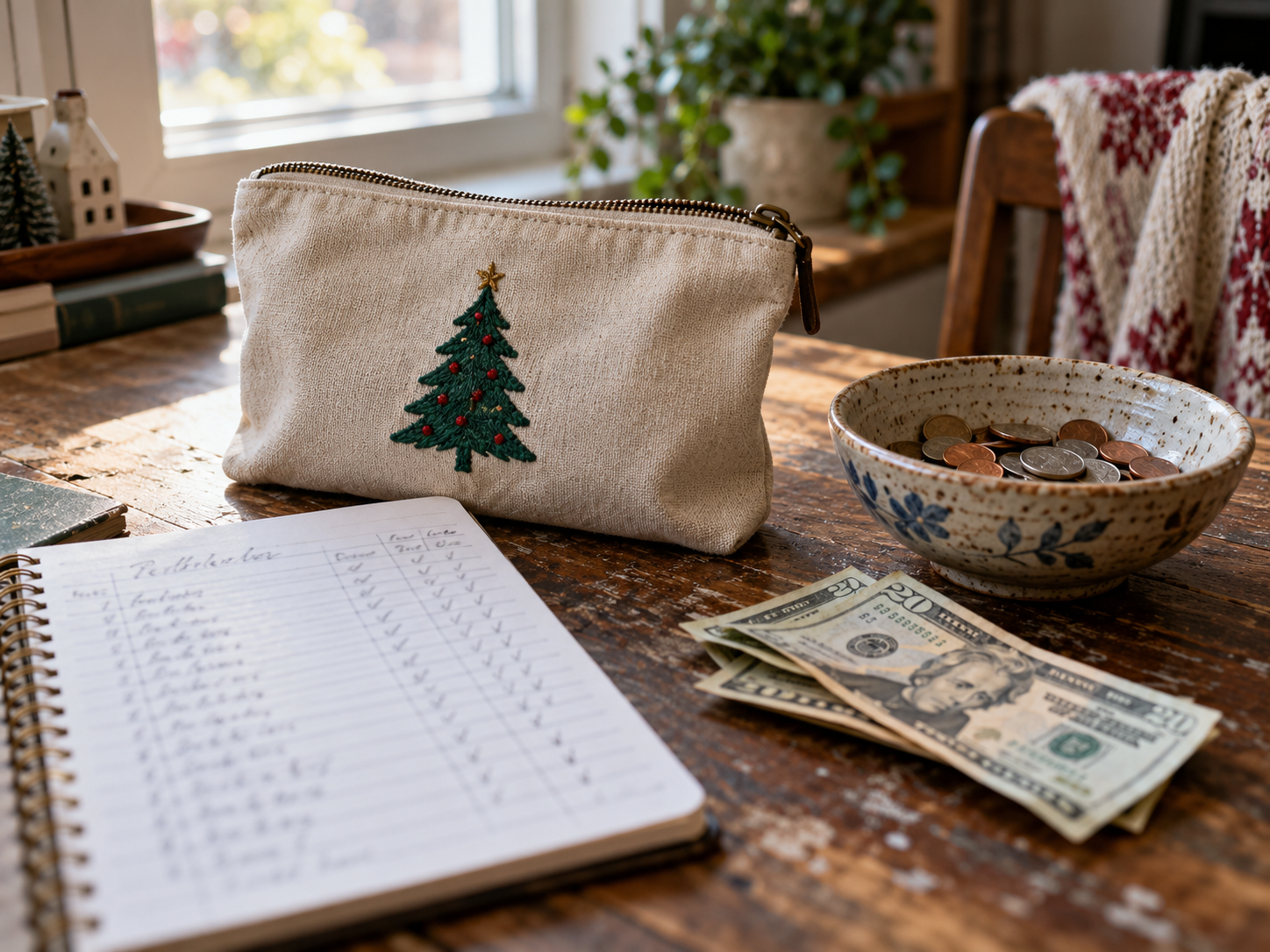
The fourth page of the printable has 52 numbered spaces. Fill one in each payday or week you make a deposit. If you get paid every other week, use the first 26 spaces and write your own dates and amounts.
Work out what Christmas actually costs your household
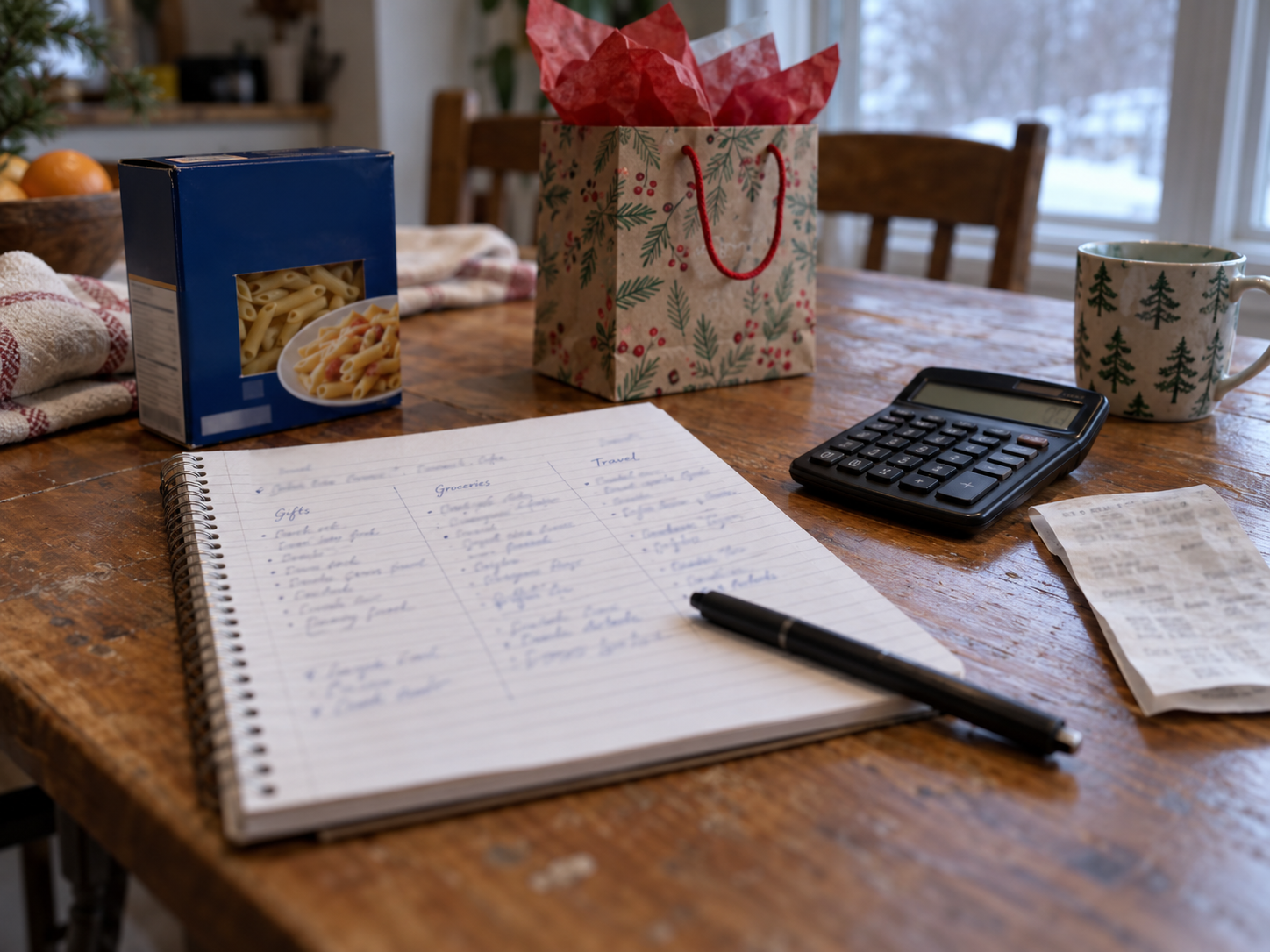
I’d make the spending list before choosing the goal. Some families need travel money more than gifts. Others stay home and spend most of their holiday budget on food for a big gathering.
Say the family wants to save $500. The plan could be:
| Christmas expense | Amount |
|---|---|
| Two children’s gifts | $180 |
| Other family gifts | $120 |
| Holiday meal and baking | $100 |
| Travel or gas | $50 |
| Wrapping and small extras | $20 |
| Money left for surprises | $30 |
| Total | $500 |
There’s room to change what matters to your family. Maybe the travel line needs $100 and you decide to skip adult gifts. That’s a real decision you can make while there’s still time.
I’d also write down anything already bought. If you paid $40 for a gift in September, it still belongs in the Christmas total even though the charge isn’t coming out of this week’s paycheck.
Where the weekly deposit money could come from
Cutting spending works only when it leaves actual cash available. If you cancel a $12 monthly subscription, that frees $12 each month, not $12 every week. And skipping a purchase you never planned to make doesn’t add money to the Christmas fund.
I’d start with expenses you control over the next few weeks. A family buying two $15 takeout meals each week might skip one and transfer the $15 they would have spent. Over eight weeks, that’s $120 if they follow through every time.
If you’ve got clothes or a small piece of furniture you don’t use, selling them locally might put a one-time amount into the fund. Check what similar items actually sell for, and remember that some things take weeks to find a buyer. Don’t build the plan around a sale until the payment is in your hands.
Put the saved money somewhere separate
A second savings account or a clearly named savings pocket can help keep Christmas money apart from the checking account used for bills. The CFPB recommends regular transfers when they fit your cash flow. You can arrange them through your bank or credit union, or transfer manually after payday.
Check your checking balance before any automatic transfer. Moving money out the night before rent clears can cause a fee or an overdraft, which defeats the purpose.
If you’re using cash envelopes, keep them somewhere secure and record the amount each time you add money. A savings account at an FDIC-insured bank also gives you access to a more secure place to hold short-term savings, as described by the FDIC.

What to do when you miss a week
If the car needs a tire or the electric bill runs higher than expected, use your money for the bill. Leave that week’s box empty or write the smaller amount you managed to save.
Then add up what’s in the account and count the weeks still available. For example, if your balance is $300, your goal is $500, and you have four weeks left, you’d need $50 a week to finish. If that doesn’t fit, change the goal. The holiday plans can be smaller.
I wouldn’t use a credit card or a buy-now-pay-later plan just to complete a savings challenge. The CFPB explains that missed payments on these plans can bring late fees, and automatic withdrawals may also cause bank fees when the account runs low.
If debt payments are already difficult to manage, a qualified nonprofit credit counselor can help review your situation. The Christmas fund can wait.
Get the free Christmas savings challenge printable
Download the free four-page Christmas savings challenge printable (PDF)
Print whichever pages you’ll actually use. The four-page PDF is made for US Letter paper, with room to write dates, deposits and running totals.
The first page helps you choose a goal and work out what you’ll need to save. Page two has eight $125 deposits that reach $1,000. Page three uses eleven $84 deposits and one $76 deposit for a twelve-week total of $1,000. And the last page gives you 52 blank deposit spaces for a different goal or a longer schedule.
Color in a box after the deposit is actually saved. If you move money out for Christmas shopping, mark the amount spent elsewhere so you don’t accidentally count it twice. The tracker measures what you’ve put aside; your spending list tracks how you use it.
A few questions before you start
Can I still save $1,000 if I start in November?
You can if there is enough money available after bills and regular expenses, but the weekly amount will be high. Six weeks to save $1,000 works out to about $166.67 a week. A smaller goal may fit far better if you didn’t start earlier.
Should I save daily or weekly?
Use your payday schedule. Weekly is easy to track for someone paid every Friday; a transfer every two weeks may be easier for someone with a biweekly paycheck. You can make smaller deposits between paydays if extra cash really does come in.
What if I already have money saved for Christmas?
Subtract that from the goal before deciding on deposits. If you’ve saved $350 toward a $1,000 target, you need another $650. With ten weeks available, that’s $65 a week.
Do I need to print all four pages?
No. Use the eight-week or twelve-week chart if that plan suits your dates, or the blank 52-deposit page for your own amounts. You can copy the rows into a notebook or Google Sheets if you prefer not to print.
Start with your next payday
Write your Christmas shopping deadline on the first page, circle the savings goal that fits your budget, and fill in the date of your next paycheck. If this year’s realistic goal is $250, choose $250. You can build a bigger fund next year by starting sooner.
Plan how to use your holiday fund with our Christmas budget guide and free planner.