

A first budget needs just three numbers to get started: what comes in, what must go out and what remains for everything else. You can work it out on paper in twenty minutes, then improve the amounts as you see what your household actually spends. Our free Budget Starter Kit gives you room for income, bills, flexible spending and a month-end check.
Table of contents
- Before you start, gather three things
- Seven steps to make your first budget
- A beginner monthly budget example
- What if your expenses are higher than your income?
- How to use the free printable budget worksheet
- Budgeting mistakes that are easy to fix
- Frequently asked questions
- Make next month easier
- A quick weekly budget check that takes ten minutes
If money is already tight, a budget won’t create extra income. It can show which bills are due, prevent avoidable fees and help you decide where a limited amount should go. You don’t have to follow a popular percentage rule or download a complicated app to begin.
Before you start, gather three things
Get your latest pay stubs, a bank or card statement and a list of bills that don’t appear every month. If you use cash, write down your best estimate of where it went. Choose a quiet time when you can make decisions without rushing. A pencil is useful because your first estimates will probably change.
Seven steps to make your first budget
Step 1: Work out your take-home income
Use the amount actually deposited into your bank account, after payroll deductions. If you get paid every two weeks, two paychecks aren’t the same as an average calendar month: 26 paychecks divided by 12 gives about 2.17 paychecks per month. For a cautious starter budget, base regular bills on two checks and plan separately for the two extra-paycheck months. If income varies, use a conservative recent month or the minimum you can reasonably expect, then adjust when money arrives.

Gather two or three pay stubs and the last three months of deposits. Include reliable benefits or other income only when you know when they’re paid. If you share bills with a partner, agree whether you’re making a household budget or a personal one. A clear income number is the foundation for the rest of the page.
Step 2: Write down fixed bills
List rent or mortgage, insurance, minimum debt payments, phone, internet, childcare and other commitments. Include the due date and how the bill is paid. Don’t assume a charge is monthly: annual insurance, car registration and school fees need a place too. Look through statements because forgotten subscriptions can hide among ordinary purchases.
For irregular bills, divide the expected annual cost by twelve and set that amount aside each month. A $240 annual payment means saving $20 monthly. If the bill is due sooner, divide by the number of paydays left instead. This prevents a predictable expense from becoming an emergency.
Step 3: Estimate flexible spending
Groceries, transportation, utilities, household supplies, clothing and personal spending change month to month. Use actual transactions to estimate each category, especially if your memory tends to underestimate small purchases. A month with holidays or a car repair may not represent your usual spending, so look across several months.
Start with broad categories. Splitting groceries into ten subcategories can wait. If your family spends about $550 on groceries, write that number down and test it against receipts rather than copying someone else’s $300 challenge. Budgets work better when the amounts reflect your household.
Step 4: Give the leftover money a job
Subtract planned bills and flexible spending from take-home income. If the number is positive, decide how much goes toward savings, extra debt payments and planned future expenses. If it’s negative, identify the gap before the month begins. You may need to reduce optional costs, negotiate bills or look for more income; cutting essentials further may not be realistic.
For example, suppose take-home pay is $3,200. Fixed bills are $1,700, flexible needs are $950 and planned extras are $250. That leaves $300. You could direct $150 to an emergency fund, $100 to upcoming car expenses and $50 to an irregular school cost. The categories add up to the full $3,200.
Step 5: Match your plan to payday dates
A monthly budget can look balanced while your account runs short before rent is due. Put income and bills on a calendar. If a large payment falls before the next paycheck, hold part of the previous check for it. Check whether billers offer a due-date change, but confirm any fees and the effective date.
Keep a small checking buffer when possible. Automatic transfers are convenient only if the money is there when they run. If your pay is unpredictable, make the savings transfer manually after essentials clear. Avoid overdraft fees caused by an overly aggressive schedule.
Step 6: Track spending without making it a second job
Choose one method: a notebook, a spreadsheet or a budgeting app you already trust. Once or twice a week, record spending and compare it with what remains in each category. You don’t need to type every receipt into five separate systems. The goal is to catch a problem while there’s still time to change the month.
If groceries are $40 over the plan, decide whether another category can safely cover it. Don’t pretend the spending didn’t happen. Record the change and consider whether your grocery estimate needs to rise next month. Consistent tracking is more useful than perfect categories.
Step 7: Review and adjust after the first month
At month’s end, compare your plan with actual spending. Which bills were higher? Which categories were unrealistic? Did you forget a birthday, medical copay or annual fee? Make two or three changes, then use the revised budget for the next month. A first budget is a starting point, and it should become more accurate with practice.
Set a ten-minute money check-in for the same day each week. If you’re budgeting with a partner, talk about upcoming costs before they happen. You can keep the format simple as long as the numbers and decisions are visible to everyone responsible for paying the bills.
A beginner monthly budget example
Say your household brings home $3,200 a month. Your rent is $1,100, utilities average $220, insurance is $160, phone and internet cost $120, and minimum debt payments are $100. Those fixed bills total $1,700. Groceries are $550, transportation is $250 and household and personal essentials total $150, bringing flexible needs to $950. Put $250 toward planned extras, $150 into emergency savings, $100 into a car repair fund and $50 toward school expenses. Everything totals $3,200.
| Category | Monthly amount |
|---|---|
| Take-home income | $3,200 |
| Fixed bills | $1,700 |
| Flexible needs | $950 |
| Planned extras | $250 |
| Emergency savings | $150 |
| Car repair fund | $100 |
| School expense fund | $50 |
| Money left unassigned | $0 |
You might decide to keep part of the final $300 as a checking buffer instead. The important thing is to know what the money is for before it’s spent.
What if your expenses are higher than your income?
Don’t force the spreadsheet to balance by writing unrealistic grocery or transportation amounts. Start with housing, utilities, food, medicine, transportation to work and minimum required payments. Then look at optional spending, due-date changes, assistance programs and ways to bring in more income. If you can’t cover essentials, contact billers and local assistance organizations early. A budget is useful even when it shows a shortfall because it gives you a clear list of what needs attention.
If debt payments are the main problem, write down each minimum payment and interest rate. Avoid skipping required payments without speaking to the lender. Free or nonprofit credit counseling may be an option, but check the provider and terms carefully.
How to use the free printable budget worksheet
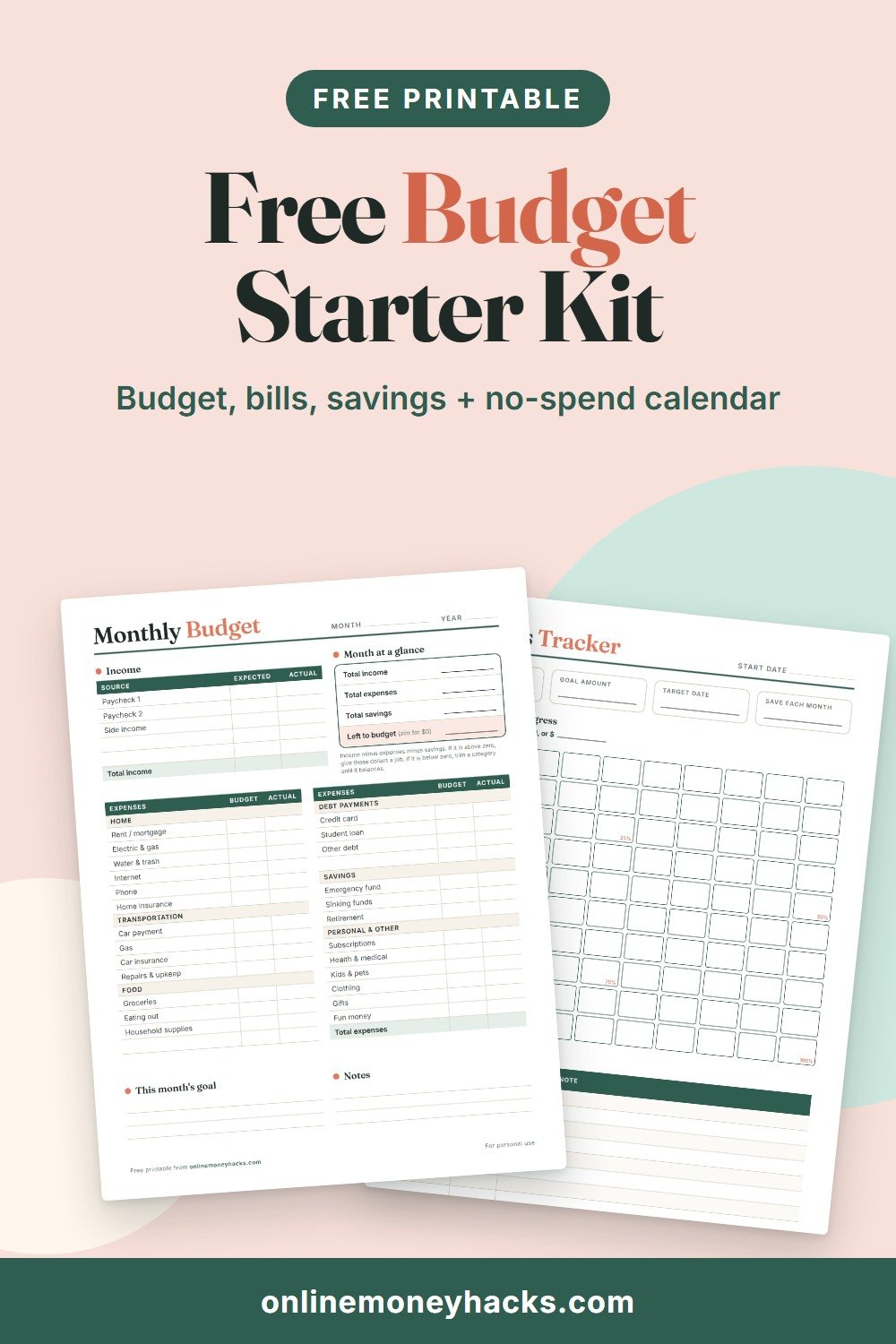
Download the free Budget Starter Kit below and print the monthly budget page once a month, or fill it in digitally if your device supports PDF annotations. Write expected income at the top. List each bill and its due date on the bill tracker page, then estimate groceries, gas and other flexible categories on the budget page. Use the actual column as the month progresses. At the bottom, compare planned and actual totals and write one change for next month.
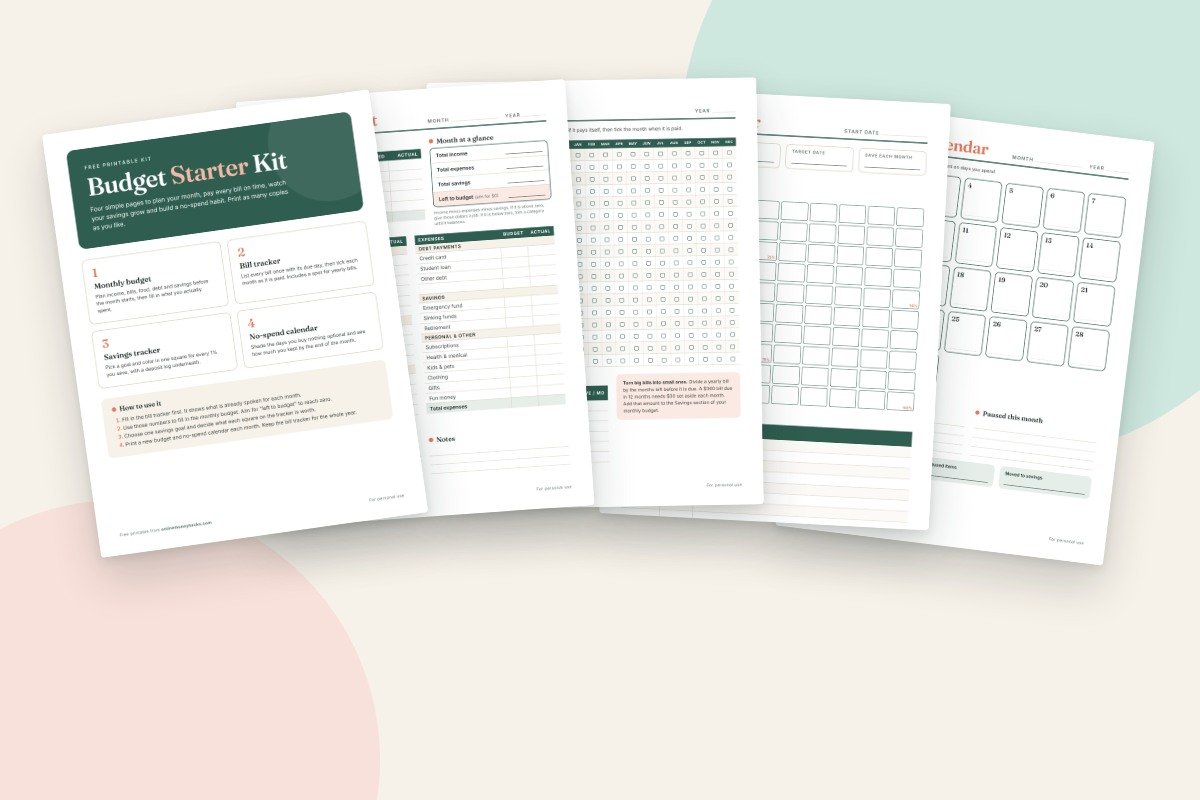
You can also recreate the same worksheet in a notebook if printing costs money. The categories matter more than the design.
Budgeting mistakes that are easy to fix
One common mistake is treating an annual bill as a surprise. Another is using a best-case income number every month, especially when hours vary. A third is leaving no room for small irregular costs, which can make the plan feel impossible after a single birthday or school event. Set aside what you can for predictable costs, and adjust estimates after reviewing real transactions.
Don’t pay for an app before you’ve tried a free method. And don’t assume you failed because you moved money between categories. The useful question is whether you knew where the money went and protected your most important bills.
Frequently asked questions
What is the easiest budget method for beginners?
A one-page monthly worksheet is enough. List income, fixed bills, flexible expenses and planned savings, then review actual spending each week. You can add more detail later.
What if I get paid every two weeks?
Use your pay dates to plan cash flow. Most months contain two paychecks, while two months in a typical year contain three. Decide ahead of time how you’ll use those extra checks.
Do I have to use the 50/30/20 rule?
No. That rule can be a reference point, but high housing costs or a low income may make it impractical. Build the budget around your real bills and goals.
How often should I update my budget?
Check spending weekly and review the full plan at the end of each month. Update sooner if income or a major bill changes.
Make next month easier
Fill in your income and the next three bills today. You can add the rest of the categories after looking at your statements. Once you’ve finished a full month, the second budget usually takes much less time because most of the numbers are already there.
A quick weekly budget check that takes ten minutes
Pick a day when you normally have a quiet moment, such as Sunday evening. Open your bank account and look at transactions since the last check. Mark the ones that belong to groceries, transportation, household costs and optional purchases. Compare each category with the amount you planned for the month. If something looks wrong, check whether a payment is pending before changing the total.
Next, look ahead to the coming week. Are there school fees, a prescription refill, a birthday or a utility payment due before the next paycheck? Put those amounts on your calendar. This step matters because a budget can appear healthy on paper while a large bill is about to leave your checking account.
Finally, decide whether to move money between categories. If you spent less on transportation but more on groceries, update both figures. Don’t create an imaginary savings balance by leaving the overspending out. Keep one short note about what you want to change next week, such as bringing lunch twice or checking the grocery list before shopping. You can make the full monthly review later; the weekly check is mainly there to prevent surprises.
Once your budget is running, build a cushion with this emergency fund plan or the 52-week money challenge.