

Money saving challenges for low income households should start with amounts that can be skipped without a penalty. A $1 payday deposit or a one-week pause on optional purchases can be more realistic than a viral $5,000 target. The eleven ideas below have different rules and costs, so choose one rather than trying to fund all of them.
Table of contents
- 1. The one-dollar payday challenge
- 2. The loose-change jar
- 3. A manual round-up challenge
- 4. The five-dollar weekly challenge
- 5. A two-week grocery-use challenge
- 6. The no-takeout weekend
- 7. A one-category no-buy week
- 8. The bill-fee check challenge
- 9. The one-dollar increase ladder
- 10. The windfall split
- 11. The spare-dollar monthly check-in
- A practical plan you can adapt
- Questions readers ask
- How to choose the right challenge when money is tight
- How to use the three printable trackers
- Your next step
1. The one-dollar payday challenge
Put $1 into savings each time you are paid. On a biweekly schedule with 26 paydays, that produces $26 in a year. The amount sounds modest, and that is the point. If $1 would leave you short for bus fare, skip it. Use a checkbox for each payday rather than pretending every household is paid weekly. Once you have a buffer, you can raise the deposit to $2 or $3 without changing the method.
2. The loose-change jar
Collect coins you genuinely receive in change, then count and deposit them periodically. Do not buy things just to get coins. If you mostly use a debit card, this may produce almost nothing, and that is fine. A jar is a visual reminder, not a guaranteed savings system. Keep cash somewhere secure and avoid leaving large amounts at home. For families with children, counting coins together can turn a small habit into a practical math lesson.
3. A manual round-up challenge
After a planned purchase, round its price to the next whole dollar in your notebook. A $6.40 purchase produces a 60-cent proposed transfer. Add the week’s round-ups and move that total only if money is available. This avoids subscription fees from apps that automate round-ups, though it takes a little attention. Never treat the round-up as free money; it still comes from your checking balance. Set a weekly cap to protect essentials.

4. The five-dollar weekly challenge
A $5 deposit every week for 52 weeks totals $260. It can work for someone with a small but reliable surplus. If you are paid twice a month, set aside $10 on each of 24 paydays for $240 instead, or add a final $20 only if feasible. Do not claim those schedules are identical. Put the exact dates on a tracker and revise them when work hours change. The useful feature is a repeatable small amount.
5. A two-week grocery-use challenge
Choose two weeks to plan meals around food you already own. Check expiration dates and food safety, then buy missing fresh ingredients rather than trying to eat only canned food. Track what groceries actually cost compared with a normal two-week period. If your usual bill is $120 and this time it is $105, the difference is $15, not the full $120. Food should remain adequate and nutritious; this is not a challenge to skip meals.

6. The no-takeout weekend
Pick one weekend when you would usually buy restaurant food and plan a meal at home. If you would have spent $24 on takeout but spend $9 on extra ingredients, the potential difference is $15. That is only savings if the money remains unspent or is transferred. People who rarely order takeout should choose another category; a challenge based on imaginary spending cannot create real savings.
7. A one-category no-buy week
Choose one optional category, such as beauty extras, décor or paid entertainment, and pause purchases for seven days. Keep essentials and already committed bills outside the rule. This is more realistic than banning all spending when you have children, medical needs or irregular transport costs. Note urges to shop and what triggered them. A pause may reveal a useful habit even when it saves no money that week.
8. The bill-fee check challenge
Review the last three statements for avoidable account fees, late charges or subscriptions. Ask the provider about a lower-cost option, but do not assume a waiver is available. If you eliminate a $5 monthly fee, future savings could be $60 over twelve months, assuming the account terms stay the same. Do not count the whole year’s savings before the charges actually stop. Keep a note of the date you made the change.

9. The one-dollar increase ladder
Start with $1 in the first week, then $2 in the second and continue through $10 in week ten. The ten deposits total $55. This is shorter than the traditional 52-week challenge and has a clearly defined ending. If week nine is difficult, pause or repeat a lower amount instead of forcing $9. A ladder works best when you can see the maximum deposit before you start.
10. The windfall split
When unexpected money arrives, decide how much is needed for overdue bills and how much can safely go to savings. For example, from a $40 refund, you might set aside $10 and use $30 for a necessary expense. This challenge has no fixed annual total because refunds, gifts and extra shifts are unpredictable. Do not build your regular budget around money that may never arrive. Record the actual amount and date rather than an optimistic forecast.
11. The spare-dollar monthly check-in
At the end of each month, review the balance after essential bills and upcoming obligations. If $3 is truly spare, transfer $3. If nothing is available, enter $0 and keep the record. Over twelve months, deposits of $3 in six months and $0 in six months total $18. That is a valid result. This method is especially useful when work hours, caregiving costs or benefit timing vary. It treats financial stability as more important than a streak.
A practical plan you can adapt
The eleven challenges are alternatives, not a checklist you must complete simultaneously. Combining every method could quietly commit money that your budget does not have. Start by writing three numbers: expected take-home income before the next payday, essential expenses due before then, and cash needed for groceries and transportation. Only the remainder is potentially available for savings. If the remainder is negative, the correct challenge is reviewing bills and seeking appropriate support, not inventing a transfer.
A hypothetical worker is paid $900 every two weeks and needs $850 for bills and living costs during that period. Their maximum theoretical remainder is $50, but an irregular expense could use it. They choose a $1 payday challenge and keep the rest as breathing room. Across 26 paydays, $1 would add up to $26 if every deposit is completed. If a month includes an unexpected $75 repair, they skip the transfer rather than charge the repair to a credit card. That is a financially sensible adjustment, not a failed challenge.
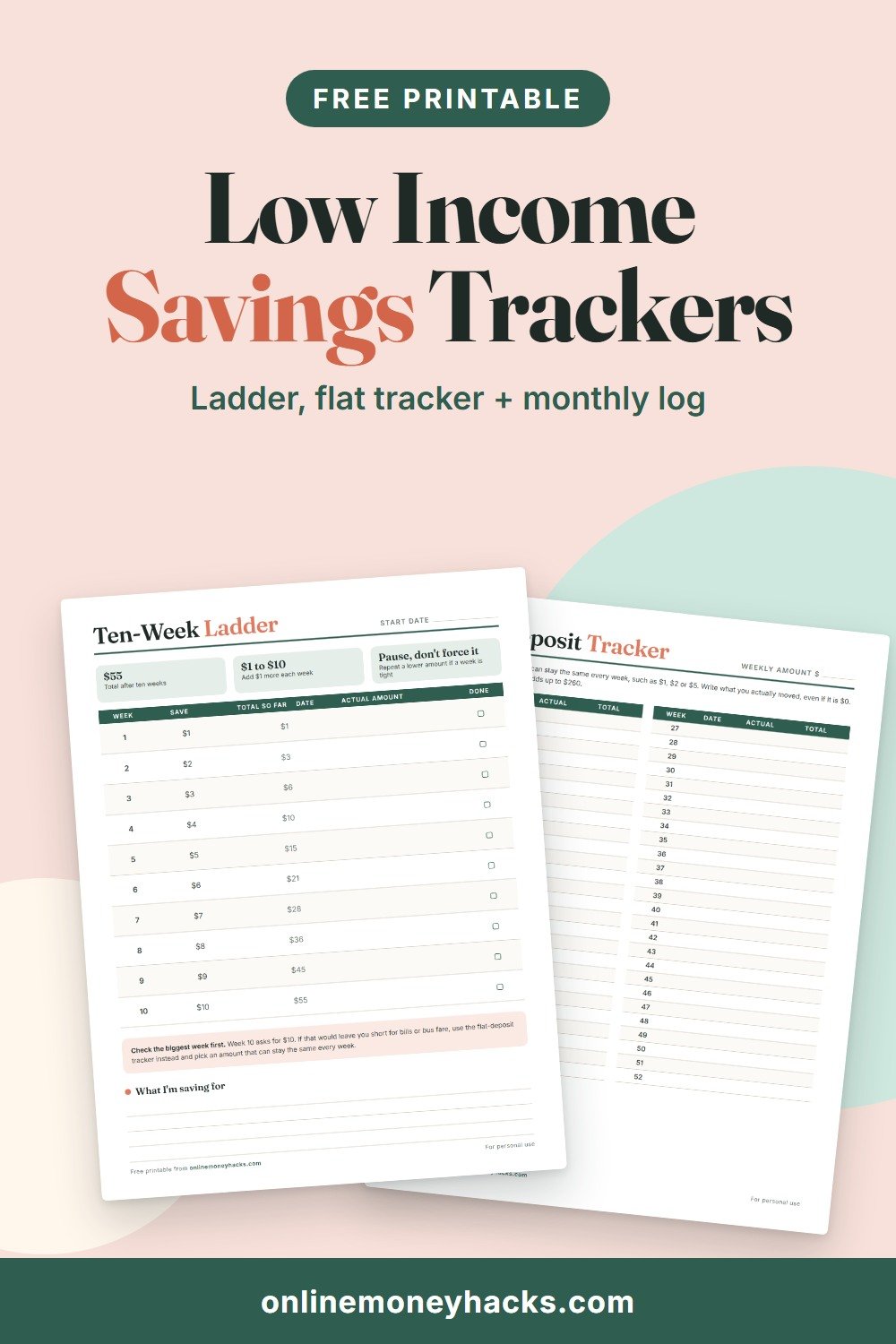
The free printable set below includes a ten-week ladder, a 52-week flat-deposit tracker and a blank twelve-month log. Each has different rules and totals. The blank log is useful for a no-buy or pantry challenge where savings cannot be predicted. Label every tracker with the assumptions and include a place for actual deposits. Readers should not have to guess whether a shaded square represents money saved or merely a day completed.
Questions readers ask
Which savings challenge is best on a low income?
The one that asks the least of your next paycheck. The one-dollar payday challenge and the bill-fee check are good first picks because they cost little or nothing and can be skipped without a penalty.
Can saving money affect my benefits?
It can for some programs that count savings or account balances. Rules differ by program and state, so check with the agency that runs your benefits before building a larger balance.
Is saving $1 at a time really worth it?
Yes, if it fits. A dollar each payday on a biweekly schedule adds up to $26 in a year, and the habit makes it easier to save more when your income allows.
How to choose the right challenge when money is tight
The first test is not whether a challenge sounds fun. It is whether the largest required deposit fits after essential bills. A plan with a tiny starting amount can become expensive later, as happens with increasing weekly and daily challenges. Read the final deposit amount before signing up for anything. If the maximum is uncomfortable, use a flat amount or a challenge that does not require deposits at all, such as reviewing subscriptions or using food already in the pantry.
A second test is how often your income arrives. Someone with steady biweekly pay can schedule a small transfer after each payday. Someone whose hours vary may need to wait until bills clear and then transfer whatever remains. Both are valid systems. A calendar full of fixed deposit dates is not automatically better than a flexible monthly review. If you receive benefits or assistance, be aware that account balances and resources can affect some programs. Check the rules that apply to your situation rather than assuming every savings account has the same treatment.
A third test is what you would do in an emergency. If a $40 repair would force you to borrow, keeping accessible cash may matter more than completing a themed challenge. Do not lock up money needed for a near-term bill. Small savings goals can build a buffer, but they cannot replace adequate income or solve every household expense.
How to use the three printable trackers
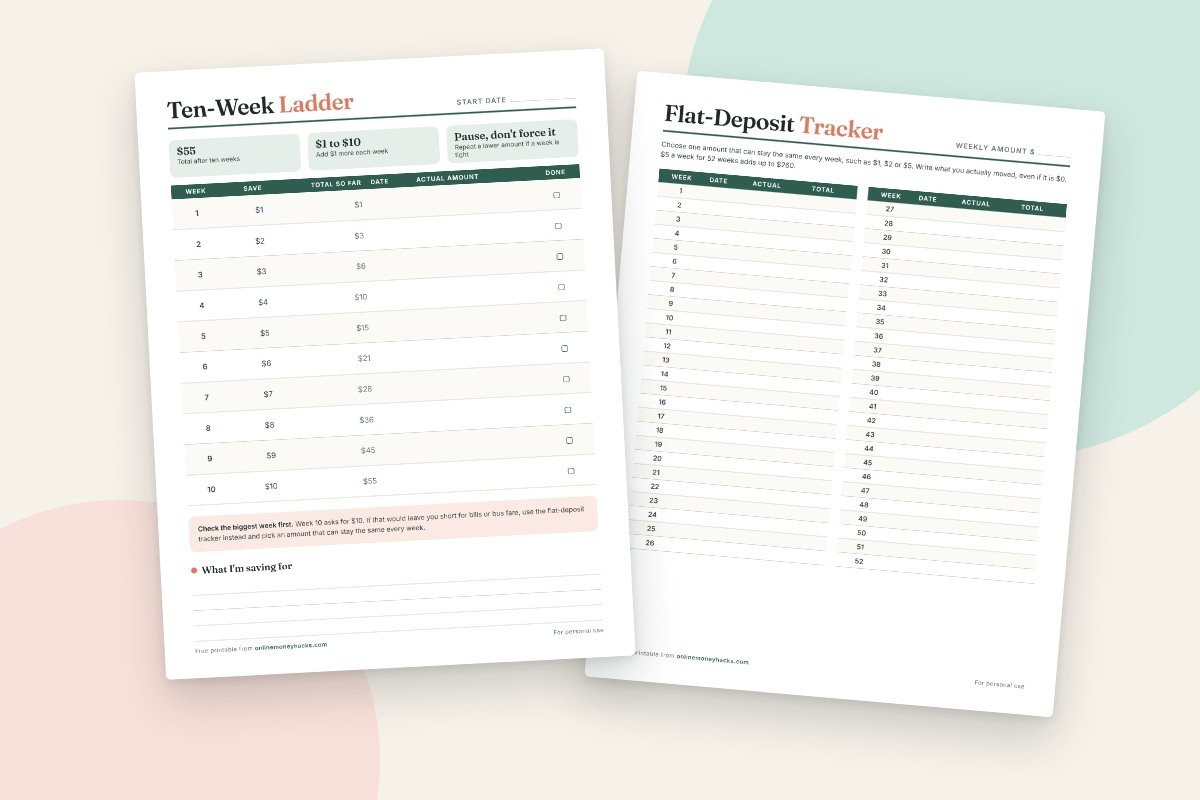
The flat-deposit sheet has fifty-two rows. You choose an amount that can remain the same from week to week, then mark the actual amount transferred. The ten-week ladder sheet lists deposits from $1 to $10, which total $55 if completed once. The twelve-month log has blank target and actual fields, making it suitable for no-buy, pantry and fee-reduction challenges where the result cannot be predicted. The printables are deliberately different because a single generic chart would misrepresent several of the ideas.
Before using a tracker, write the date you expect to review it and the account or envelope where money will be kept. Avoid recording account numbers or other private details on a sheet left in a public place. At the end of the month, reconcile the boxes with the actual balance. If the amounts differ, correct the record. The point is to understand what happened, not to preserve a perfect-looking page.
Your next step
Pick the challenge that asks the least of your next paycheck. Write down the first date and a deposit you can afford after bills. A small amount recorded accurately is a better beginning than an impressive target you cannot safely fund.
Want more ideas that start small? Try the 52-week money challenge at $5 a week, or pick one of these monthly savings challenges.