

The 365-day penny challenge begins with one cent and increases by a cent each day, reaching $3.65 on day 365. Completing every deposit saves $667.95. That total is correct, but the later months cost much more than the early ones, so the schedule deserves a careful look before you start.
Table of contents
- 1. What the 365-day penny challenge actually asks you to save
- 2. Check the $667.95 total before you begin
- 3. Choose cash, a notebook or a digital transfer
- 4. Bundle seven days into one weekly deposit
- 5. Reverse the order when winter bills are higher
- 6. Use a half-penny target without collecting fractions of coins
- 7. Make missed days visible without adding pressure
- 8. Decide what counts as a completed deposit
- 9. Handle a leap year or a midyear start correctly
- 10. Use the printable as a record, not a promise
- 11. Teach children with a smaller version
- 12. Choose a purpose for the money before you save it
- A practical plan you can adapt
- Questions readers ask
- The first and last month are not equally expensive
- A weekly check-in that takes five minutes
- Your next step
1. What the 365-day penny challenge actually asks you to save
The rule is simple: on day one, save one cent; on day two, save two cents; and continue increasing the amount by one cent a day. Day 100 calls for $1, day 200 for $2 and day 365 for $3.65. The amounts look tiny at the beginning, which is part of the appeal. But the plan is not equally easy throughout the year. Someone who begins in January will face the largest deposits around the holidays. Look at the last thirty days before deciding that the challenge is effortless. A small daily amount is still a commitment when groceries and transportation already use most of your paycheck.
2. Check the $667.95 total before you begin
There are 365 deposits, from $0.01 to $3.65. The arithmetic is 365 × 366 ÷ 2 = 66,795 cents, or $667.95. This is the total if every day is completed once, without withdrawals. It is not interest earned and it is not a promise that you will have extra cash at year-end. The first 30 deposits total $4.65, while the last 30 total $105.15. That difference explains why a challenge that feels easy in the first month can become demanding later. If you need a smaller target, decide now rather than waiting until the high-deposit weeks.
3. Choose cash, a notebook or a digital transfer
You do not need 365 physical pennies or daily trips to a bank. A notebook or printable tracker can record the amount assigned to each day. If you prefer a bank account, combine several daily amounts and transfer once a week. Check whether your bank charges transfer or maintenance fees. A fee that exceeds the day’s contribution defeats the purpose. Cash jars can be useful for teaching children about coins, but storing hundreds of dollars at home introduces theft and loss risk. Use whichever method makes the saved balance easy to verify.
4. Bundle seven days into one weekly deposit
A weekly version preserves the same annual target while requiring fewer transactions. Days one through seven add up to 28 cents. Days eight through fourteen add up to 77 cents. Each later seven-day block costs more because the assigned daily amounts rise. Write the exact seven days covered beside each transfer so you do not count the same day twice. The final day of a 365-day challenge stands alone after 52 complete seven-day blocks. If your paycheck comes every other Friday, you can combine two weekly totals, provided the amount fits after bills.
5. Reverse the order when winter bills are higher
The reverse penny challenge starts at $3.65, then $3.64, and continues downward until one cent on the last day. It still totals $667.95. This can work for a household with more room early in the year and expensive holiday months. It is not automatically easier: the first month now becomes the most expensive. Check when annual insurance, school costs or other major expenses arrive. Reverse the schedule only if it matches your cash flow, rather than choosing it because the first few days sound exciting.
6. Use a half-penny target without collecting fractions of coins
If $667.95 is too high, a half-size version would target $333.975 mathematically. Because you cannot deposit half a cent, use a rounded plan instead. One option is to save the original daily amount on alternating days and skip the others; the total depends on which dates you choose. A cleaner alternative is a flat $1 per day for 365 days, totaling $365, or 50 cents per day, totaling $182.50. Those are different challenges, not misleading claims that the standard penny plan costs half as much. Print the version you will actually follow.
7. Make missed days visible without adding pressure
When you miss a deposit, leave the box blank and note the reason if useful. You can make it up later, but only after necessary bills are covered. Do not treat a missed day as a debt that must be repaid with interest. If the amounts begin rising faster than your income, pause and choose a flat weekly deposit instead. The useful habit is checking available money and moving some of it when feasible. A perfect calendar is not worth overdraft charges or a new credit card balance.
8. Decide what counts as a completed deposit
Color a day only when the money is actually set aside. A note that says ‘will transfer Friday’ is a plan, not a completed deposit. If you combine transfers weekly, mark the seven days after the bank transaction posts. Keep a running balance so you can reconcile the chart with your account. For example, a weekly transfer of 28 cents for days one through seven should leave the tracker showing 28 cents saved, not seven separate bank deposits. This distinction prevents accidental double-counting.
9. Handle a leap year or a midyear start correctly
The standard challenge contains 365 deposits, regardless of the date you begin. If you start in a leap year and want to save every calendar day, adding a 366th deposit of $3.66 raises the total to $671.61. To keep the advertised $667.95, complete only 365 numbered deposits and use the extra date as a rest or catch-up day. Starting in June works just as well as starting in January; number the days from your personal start date. The math depends on deposit numbers, not calendar labels.
10. Use the printable as a record, not a promise
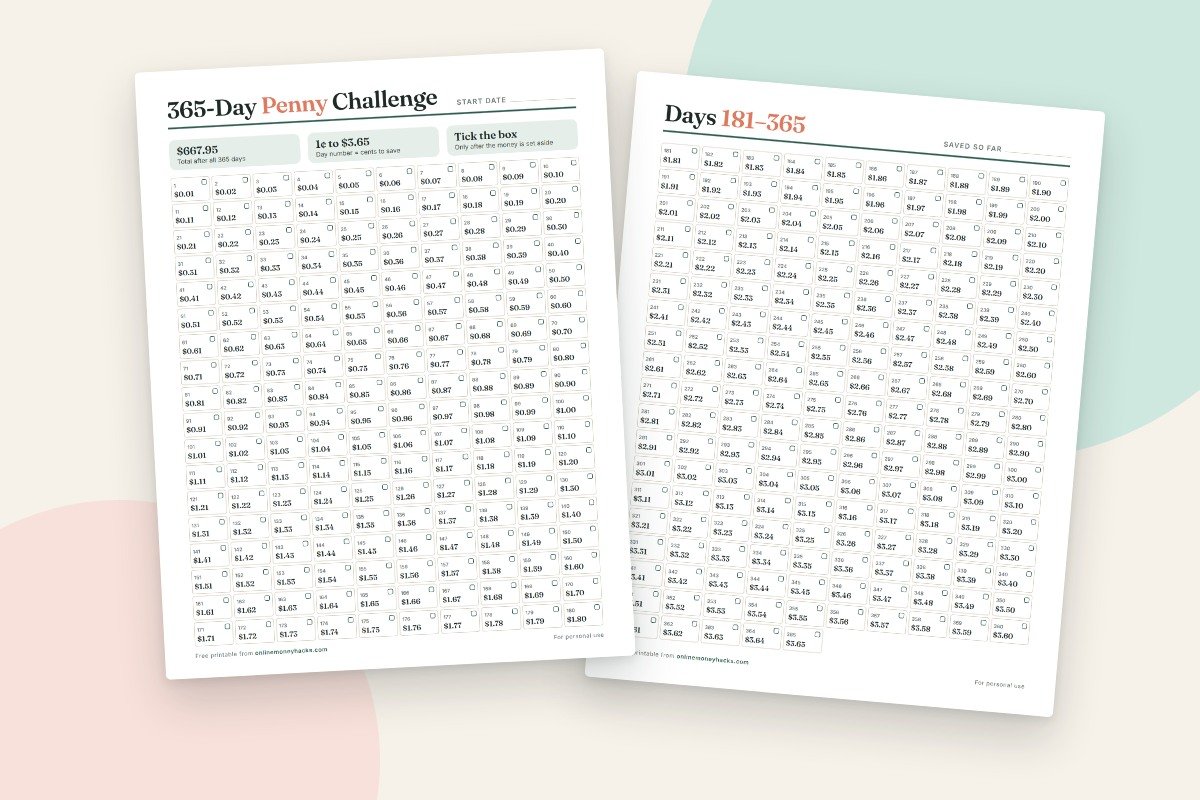
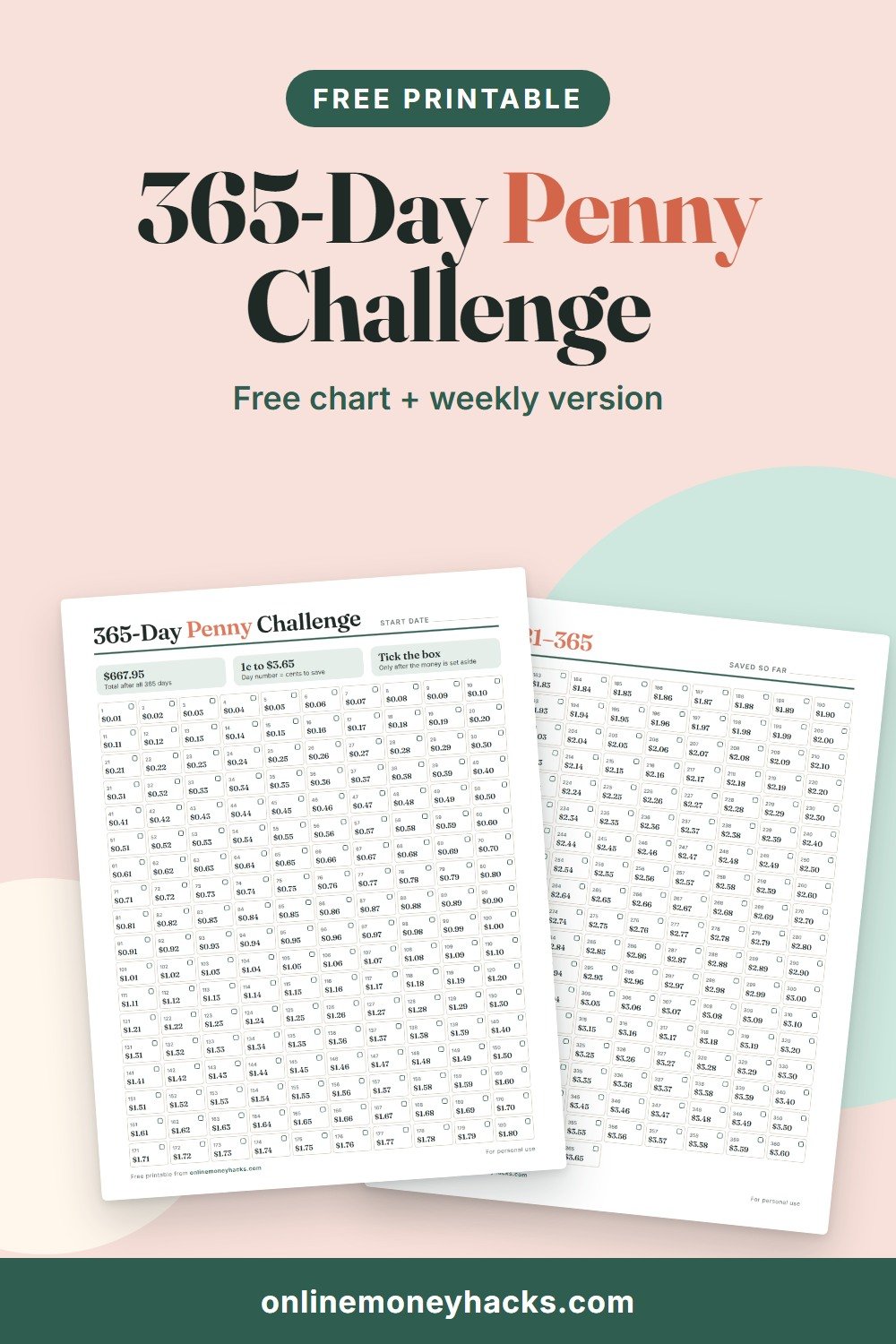
A useful chart needs all 365 numbered days, the amount for each, and a box to tick. The free printable below has exactly that on two pages, plus a third page that bundles the days into 52 weekly totals for people who prefer one transfer a week. Print it at normal size so the numbers stay easy to read.
11. Teach children with a smaller version
Children may enjoy watching a jar fill, but the full $667.95 target can be unrealistic for an allowance. Try the first 30 days, which total $4.65, or choose ten cents each week for ten weeks, totaling $1. A child can record deposits and count the coins with an adult. Avoid tying the challenge to guilt about spending on school necessities or food. The lesson is understanding how repeated amounts add up, not reaching an arbitrary large number.

12. Choose a purpose for the money before you save it
A goal makes it easier to decide whether to continue when the deposits rise. Perhaps the balance is for a car-repair buffer, a winter utility bill or a small holiday fund. Write that purpose at the top of the tracker. If you already have high-interest debt or overdue essential bills, compare the benefit of setting cash aside with the cost of those obligations. Savings challenges are tools, not universal financial priorities. Revisit the purpose every month and change course if your circumstances change.
A practical plan you can adapt
Here is a worked example for someone paid every Friday. They choose to transfer the first seven days together, totaling $0.28. On the second Friday they transfer $0.77, bringing the running balance to $1.05. They keep the numbered daily chart but make only one bank transaction each week. If a Friday paycheck is smaller than expected, they mark that week as pending and return to it when bills are paid. The method avoids 365 bank transfers without changing the mathematical target. It also makes the real balance visible rather than relying on a row of colored squares.
A separate option is to ignore the rising schedule entirely. Fifty cents a day gives $182.50 over 365 days. One dollar a day gives $365. Those totals are easier to predict because every week costs the same, apart from how many days are included. Compare the last month of the rising plan with your actual budget before choosing between them. The best savings plan is the one you can fund without borrowing to finish it.
Before posting a savings figure online, distinguish contributions from interest. The $667.95 calculation assumes only deposits. A savings account may pay interest, but the rate, timing, compounding method and fees vary. Do not promise a higher ending balance without those details. If you withdraw $40 for a necessary expense, the remaining challenge balance is $40 lower until you replace it. Keeping that record honest is more useful than a perfect-looking graphic.
Questions readers ask
How much does the penny challenge cost each month?
It rises every month. The first 30 days total $4.65, while the last 30 days total $105.15. Look at the final month before you start so the end of the challenge does not catch you off guard.
Can I do the penny challenge in reverse?
Yes. Start with $3.65 on day one and save one cent less each day. The total is still $667.95, but the most expensive days come first, so it suits people with more room early in the year.
Can I start the penny challenge in the middle of the year?
Yes. Number your 365 days from your own start date. The total depends on the deposit numbers, not the calendar month you begin in.
The first and last month are not equally expensive
The opening month of the standard plan can feel almost effortless. That is exactly why you should look ahead. Deposits increase daily, so the later weeks use a larger share of your available cash. If you begin the plan in January, the final stretch may coincide with gifts, travel, heating bills and annual renewals. Nothing in the challenge automatically sets money aside for those other expenses. Put the last month’s total beside your actual December budget and ask whether the deposit is affordable. If it is not, reversing the schedule or using a flat daily amount may be a better choice.
Do not confuse the number of boxes filled with the amount saved. The first hundred boxes represent much less money than the final hundred. That makes the chart visually satisfying but potentially misleading. Add a running dollar balance to your weekly review. When you see a month that is difficult, change the plan before an overdraft occurs. The tracker is there to help you make decisions, not to pressure you into following a number sequence at any cost.
A weekly check-in that takes five minutes
On the same day each week, check the balance in the account or jar, mark the numbered days covered by the deposit and look at the next week’s total. Write down any days that are still pending. If you are paid biweekly, check the combined amount for the next two weeks before payday. This gives you time to account for groceries and fuel. Keep the record in one place instead of juggling multiple notes on your phone.

If you are saving for a specific bill, write its due date on the tracker. A challenge that ends after the bill is due will not solve that problem unless you change the timing. For a car repair buffer or other flexible goal, the date may matter less than building a balance you can actually access. Choose the schedule that serves the purpose of the money. The original penny pattern is only one way to get there.
Your next step
Choose your start date, then look at the last thirty deposits before you print the tracker. If those amounts do not fit your budget, choose a flat daily alternative. Saving less consistently is better than borrowing to complete a challenge.
Want a different format? Try the 52-week money challenge or the 100 envelope challenge, both with free printable trackers.